

What is SAP?
SAP is one of the world’s leading enterprise software companies that provides business solutions for organizations across industries. SAP stands for Systems, Applications, and Products in Data Processing. It helps companies manage business processes such as finance, sales, procurement, manufacturing, human resources, and customer services through integrated software applications.
SAP software is widely used by small businesses, multinational corporations, and government organizations to streamline operations and improve productivity. By centralizing business data into a single system, SAP enables real-time reporting, better decision-making, and improved operational efficiency.
Over the years, SAP has evolved from traditional ERP systems into intelligent cloud-based enterprise solutions powered by Artificial Intelligence, machine learning, analytics, and automation technologies.
Evolution of SAP ERP Systems
SAP has continuously upgraded its ERP technologies to meet changing business requirements.
The journey started with SAP R/1, a basic financial accounting system with a single-tier architecture. SAP later introduced SAP R/2, which supported mainframe computing and integrated multiple business functions.
The most significant transformation came with SAP R/3, which introduced a three-tier client-server architecture. This system became highly popular because it integrated different departments like finance, logistics, HR, and sales into one platform.
SAP ECC (ERP Central Component) later became the standard ERP solution for enterprises worldwide. Today, organizations are moving toward SAP S/4HANA, SAP’s next-generation intelligent ERP platform powered by the SAP HANA in-memory database.
SAP S/4HANA provides faster performance, real-time analytics, cloud integration, and AI-driven business capabilities.
Understanding SAP Ecosystem Architecture
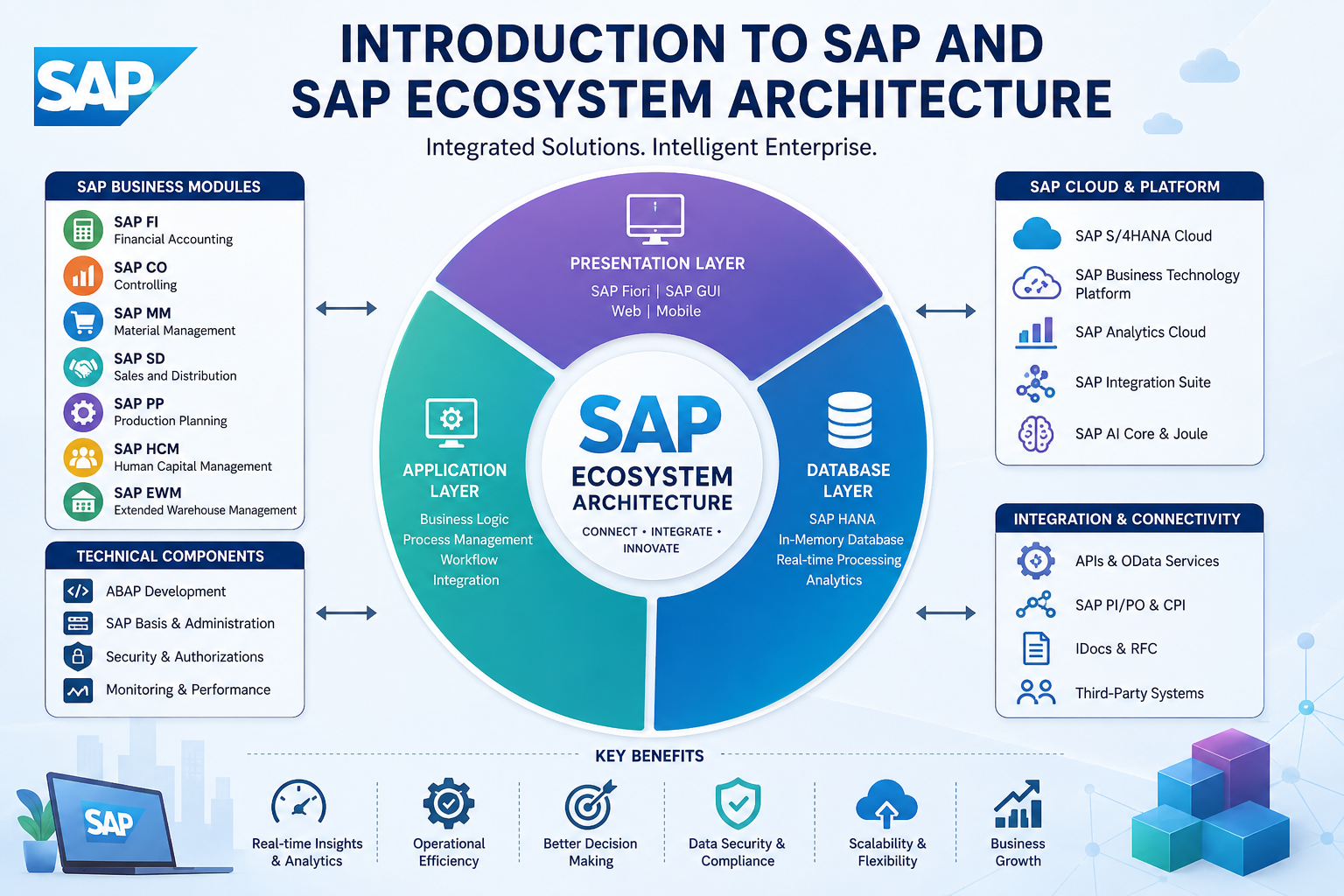
SAP ecosystem architecture refers to the complete framework of SAP applications, databases, cloud platforms, user interfaces, integration tools, and analytics solutions that work together to support enterprise operations.
The SAP ecosystem is designed to help organizations manage end-to-end business processes efficiently. It integrates departments such as finance, procurement, sales, inventory, production, customer relationship management, and human resources.
The SAP ecosystem mainly consists of three major layers:
- Presentation Layer
- Application Layer
- Database Layer
Each layer performs specific business and technical functions.
Presentation Layer
The presentation layer is the front-end interface through which users interact with SAP applications. It provides dashboards, reports, workflows, and transaction screens for employees and administrators.
Popular SAP user interfaces include:
- SAP GUI
- Web applications
- Mobile applications
- SAP Fiori
SAP Fiori is SAP’s modern user experience platform that offers responsive and role-based applications. It simplifies navigation and improves productivity with user-friendly interfaces accessible across devices.
Application Layer
The application layer is responsible for business logic and transaction processing. This layer processes user requests and executes business functions such as accounting, inventory management, procurement, and sales operations.
The application layer also handles:
- Workflow automation
- Business rules
- Data validation
- Reporting
- System integration
SAP application servers ensure smooth communication between users and the database layer.
Database Layer
The database layer stores and manages organizational data. SAP systems traditionally used databases like Oracle and SQL Server, but modern SAP systems primarily use SAP HANA.
SAP HANA is an in-memory database designed for real-time processing and analytics. Unlike traditional databases, SAP HANA stores data in memory instead of disks, enabling faster reporting and transaction processing.
Key features of SAP HANA include:
- Real-time analytics
- Faster data processing
- Predictive analytics
- AI integration
- Advanced reporting capabilities
SAP HANA plays a major role in improving enterprise performance and decision-making.
Major SAP Modules
SAP provides different modules for various business functions.
SAP FICO
SAP FICO manages financial accounting and controlling processes including balance sheets, financial reporting, and cost management. Master your financial management skills with our SAP FICO Course Online designed for beginners and professionals. Learn SAP Financial Accounting, Controlling, reporting, configuration, and real-time business processes through expert-led training and practical projects. Build job-ready SAP FICO expertise and advance your career with flexible online SAP certification training.
SAP MM
SAP Material Management handles procurement, inventory management, and vendor operations. Enroll in our SAP MM Course Online to gain expertise in Material Management, procurement, inventory management, vendor management, and supply chain processes. Learn real-time SAP MM implementation with hands-on projects and expert guidance. Build industry-ready SAP skills and boost your career opportunities with flexible online SAP training programs.
SAP SD
SAP Sales and Distribution manages customer orders, billing, shipping, and sales activities. Join our SAP SD Course Online and learn Sales and Distribution processes including order management, billing, shipping, pricing, and customer master data. Gain hands-on experience with real-time SAP SD projects and expert-led training. Develop job-ready SAP skills and enhance your career opportunities with flexible online SAP certification training.
SAP PP
SAP Production Planning supports manufacturing and production operations.Advance your manufacturing and production planning skills with our SAP PP Course Online. Learn production planning, material requirements planning, capacity planning, shop floor control, and real-time SAP PP processes through practical projects and expert training. Build industry-ready SAP expertise and grow your career with flexible online SAP certification courses.
SAP EWM
SAP Extended Warehouse Management improves warehouse operations and inventory tracking.Master warehouse and supply chain operations with our SAP EWM Course Online. Learn inventory management, warehouse structure, inbound and outbound processes, RF framework, and real-time SAP EWM implementation through hands-on projects and expert-led training. Build job-ready SAP EWM skills and enhance your career with flexible online certification programs.
These modules work together within the SAP ecosystem to provide integrated business management.
SAP Cloud and Integration Technologies
Cloud computing has transformed the SAP ecosystem significantly. SAP now offers cloud-based enterprise solutions that provide scalability, flexibility, and remote access.
One of the most important cloud platforms is SAP Business Technology Platform. SAP BTP helps organizations develop applications, automate workflows, manage integrations, and implement analytics and AI solutions.
SAP also supports integration with third-party systems using APIs, middleware, and cloud integration technologies. Common SAP integration tools include:
- SAP PI/PO
- SAP CPI
- REST APIs
- OData Services
- IDocs
These technologies enable seamless communication between SAP and non-SAP applications.
SAP and Artificial Intelligence
SAP is increasingly integrating Artificial Intelligence into its enterprise applications. AI helps businesses automate repetitive tasks, improve forecasting, and enhance decision-making.
SAP AI capabilities include:
- Intelligent automation
- Predictive analytics
- Chatbots
- Automated invoice processing
- Demand forecasting
- Smart procurement
SAP Joule is SAP’s AI-powered assistant designed to improve productivity and simplify enterprise operations.
AI integration is making SAP systems more intelligent, efficient, and user-friendly for modern businesses.
Career Opportunities in SAP
SAP professionals are in high demand globally because organizations continue to adopt digital transformation and cloud ERP solutions.
Popular SAP career roles include:
- SAP Functional Consultant
- SAP ABAP Developer
- SAP Basis Administrator
- SAP Fiori Developer
- SAP Security Consultant
- SAP Data Analyst
- SAP Cloud Consultant
Professionals with SAP skills can find opportunities in industries such as manufacturing, retail, banking, healthcare, logistics, and IT services.
Learning SAP technologies can provide strong career growth opportunities in countries like the USA, Canada, Germany, Australia, and India.
Conclusion
SAP has become one of the most important enterprise software platforms in the world. Its ecosystem architecture integrates business applications, databases, cloud technologies, analytics, and AI-driven solutions into a unified system.
From finance and procurement to supply chain and customer management, SAP helps organizations improve efficiency, reduce operational costs, and make data-driven decisions. Technologies like SAP S/4HANA, SAP HANA, SAP Fiori, and SAP BTP continue to shape the future of intelligent enterprises.
As businesses increasingly adopt cloud computing and automation, SAP skills remain highly valuable for both organizations and IT professionals. Understanding SAP ecosystem architecture is essential for anyone looking to build a successful career in enterprise technology and digital transformation.